The 8 p.m. notes moment
You open your notes at 8 p.m., promising yourself three focused hours. At 8:40 you're reorganizing your desk. At 9:15 you're deep in a video about octopuses. At 11 p.m. the exam is closer and nothing moved.
That's not a discipline problem. That's an ADHD brain running on a system built for someone else's brain — and it's fixable, starting today.
Why the usual advice doesn't work
Most study tips assume you can estimate time, hold a plan in your head, and just start. ADHD changes all three.
- Time blindness. "I'll study for two hours" means very little when your brain doesn't register how fast those two hours move. Deadlines feel unreal until they're suddenly on top of you — a pattern researchers now describe as a core executive-function difference, not a motivation gap (Simply Psychology).
- Working memory load. Holding "read chapter 4, then outline the essay, then flashcards" in your head competes with actually doing any of it. Every plan you don't write down is a plan your brain has to re-decide, over and over (Brain.fm).
- The all-or-nothing start. Research on college students with ADHD symptoms finds their study habits aren't about how much they study, but about starting, switching tasks, and sustaining effort — the entry point breaks down before the content ever does (PubMed).
None of that means you need more willpower. It means you need the plan to live somewhere other than your head.
The system: one day, laid out where you can see it
This isn't a to-do list. It's a single visual day you build once, then just move through.
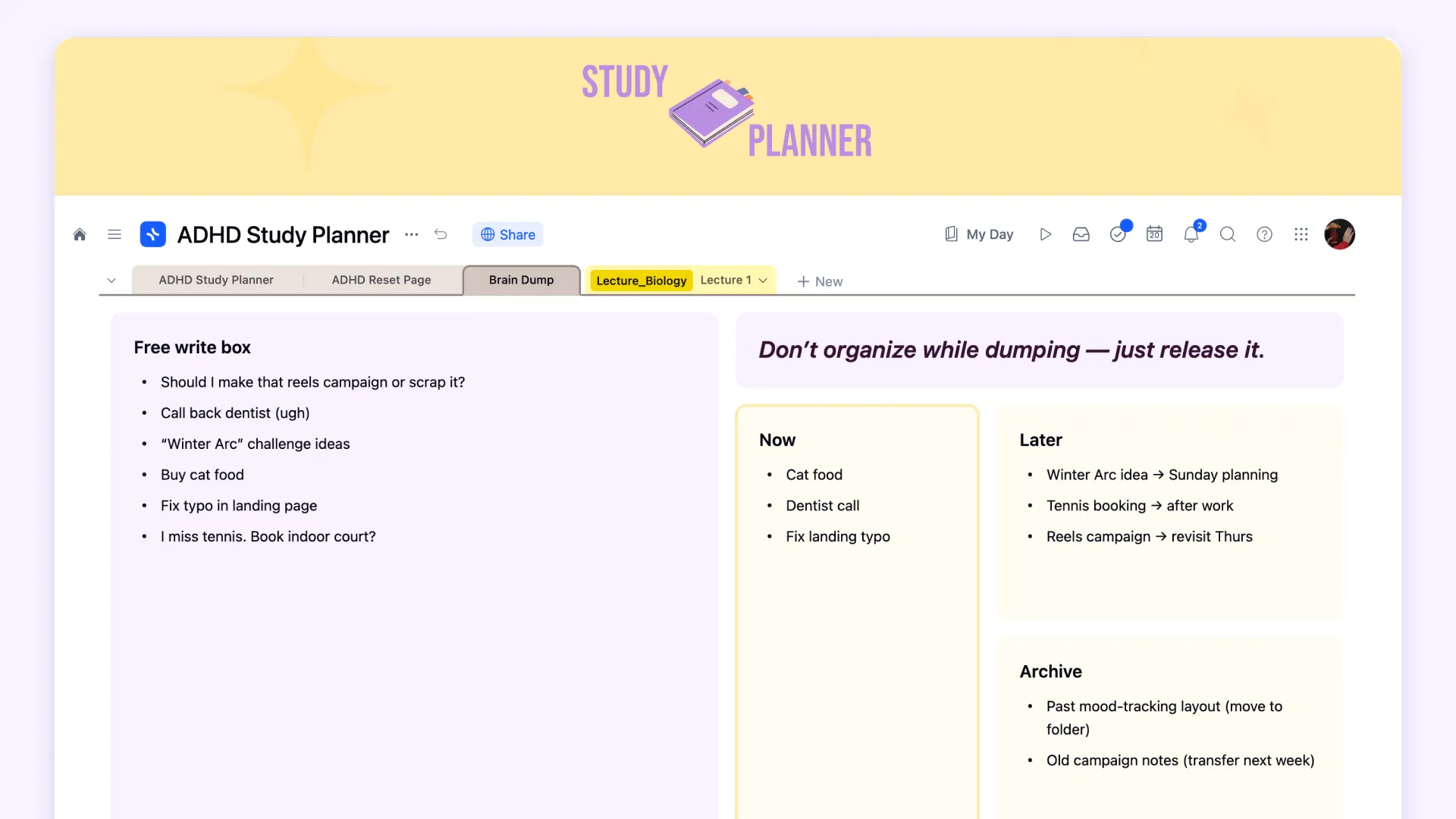
Dump first, sort never.
Before you study anything, get every assignment, reading, and looming deadline out of your head and onto one canvas — subjects, due dates, the vague "I should probably also…" tasks. Nothing has to be organized yet. It just has to be out.
Turn the day into blocks you can see, not estimate.
Instead of "study biology for a while," give biology a tile with a start and an end. Time blindness loses its grip the moment time has a shape on screen instead of a guess in your head.
Borrow focus with a body double.
Studying next to someone else — in person, on a call, or in a virtual co-working session — measurably helps ADHD brains start and stay in a task (BACA, Flow Club). Book that session the same way you book the study block. It's not cheating. It's an accommodation that works.
One tile, one task, one done.
Break each subject into tiles small enough to finish, not just start. "Outline essay intro" beats "write essay." Every checked box is proof your brain can register — momentum you can actually see building.
Close the day on purpose.
Before you stop, glance at what moved and drop tomorrow's first task onto its block. You're not starting from zero tomorrow — you're picking up exactly where today left off.
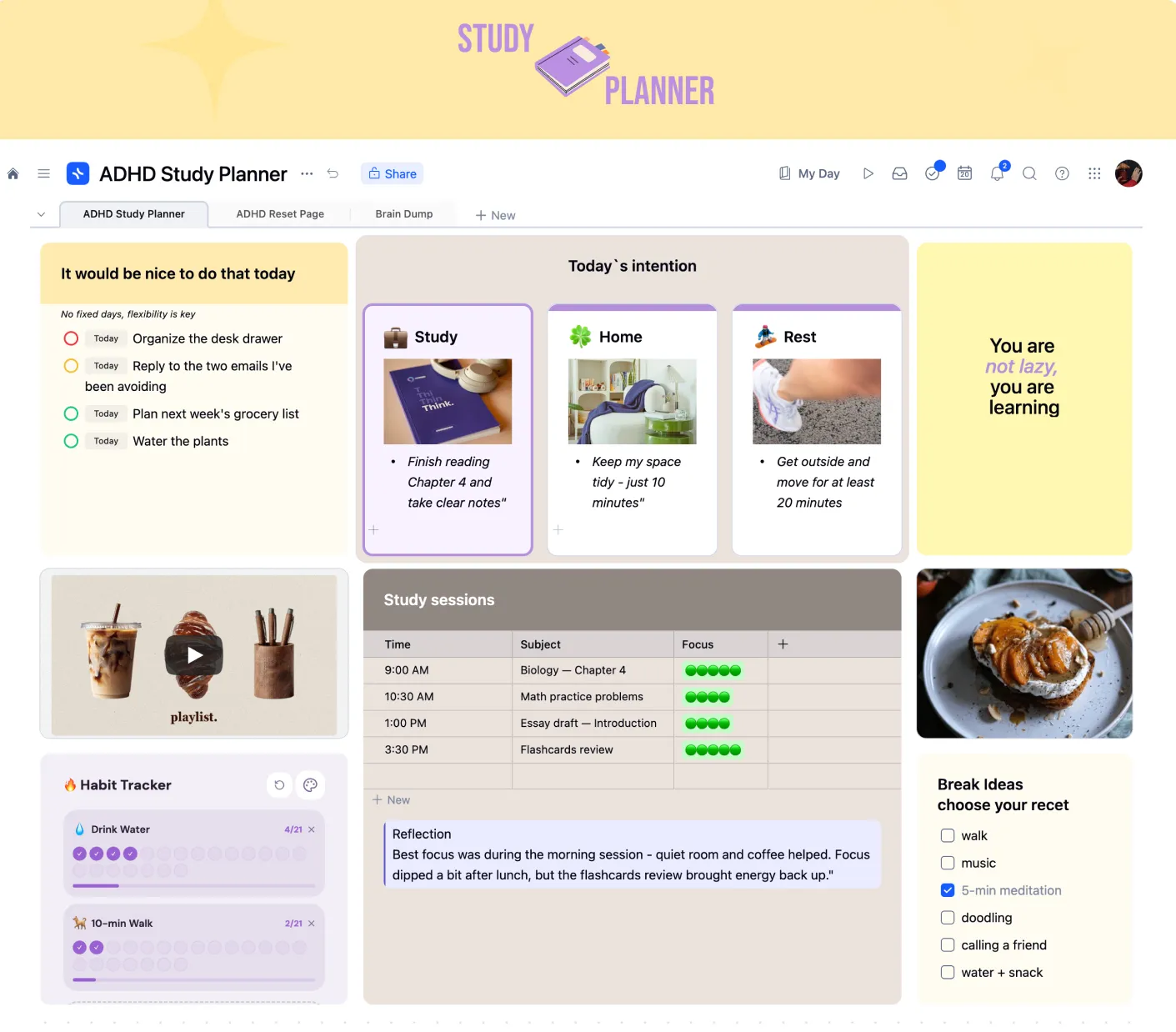
Where this lives: the ADHD Study Planner
This is exactly what the ADHD Study Planner template gives you in xTiles: one visual day, subject tiles you color and size yourself, checklists that show progress at a glance, and a layout that holds the whole picture — so your brain doesn't have to.
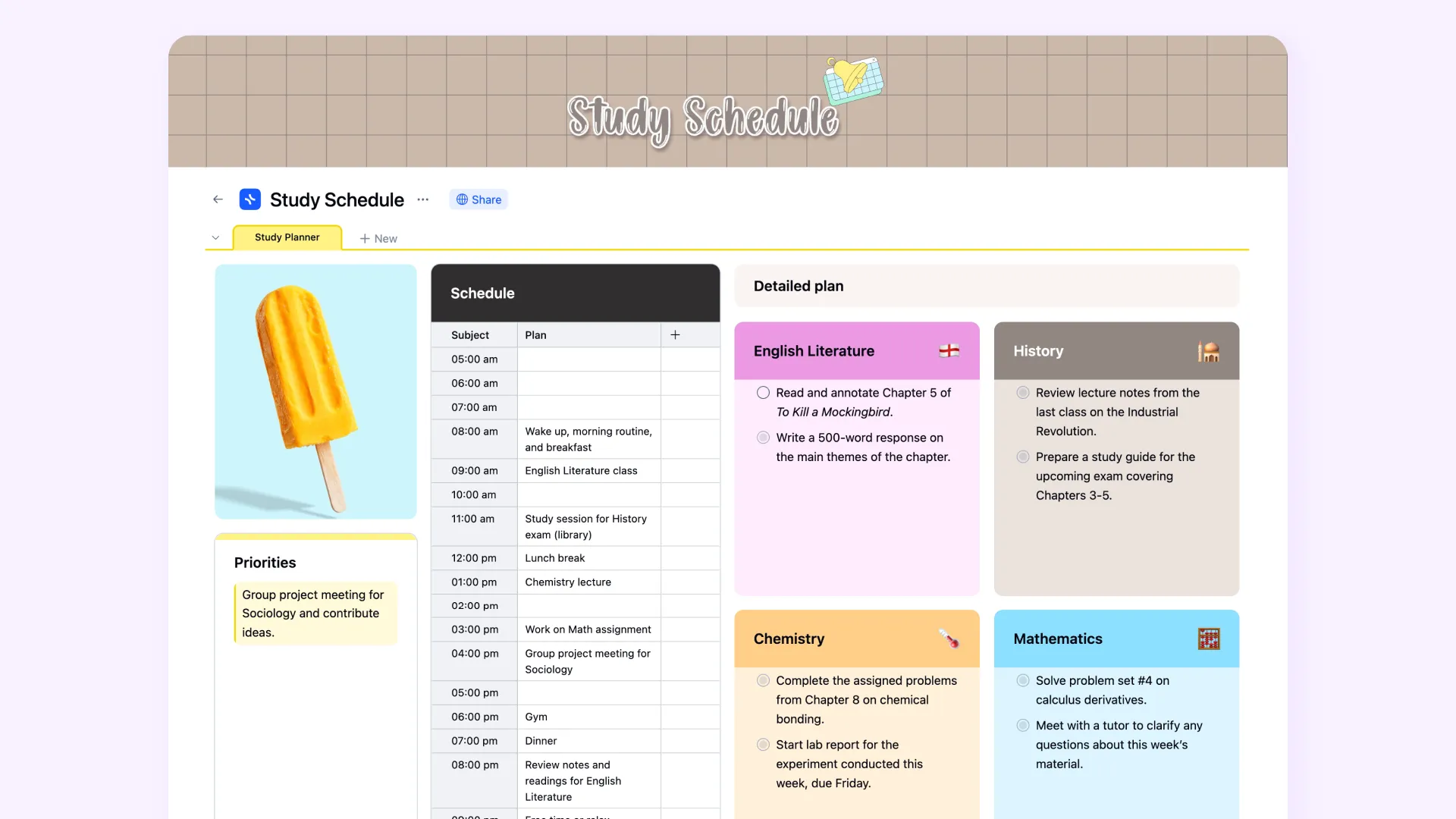
If you just want the hour-by-hour layout on its own, without the rest of the planner, the Study Schedule template does that by itself.
Your thoughts already know what needs to happen this week. The planner just gives them a place to take shape.