The 6 p.m. fridge moment
It's 6 p.m. The fridge is open. You know there's food in there — you just bought it — but none of it turns into a meal in your head. Fifteen minutes later you're ordering takeout again, telling yourself you'll "actually plan next week."
Next week goes the same way. That's not a willpower problem. It's what happens when a task built on constant decisions meets a brain that runs out of decisions fast.
Why meal planning advice doesn't stick
Most meal-planning tips assume you'll decide once and follow through. ADHD makes both halves harder than they sound.
- Decision fatigue, every single day. "What's for dinner" isn't one decision — it's dozens of small ones (what's in the fridge, what needs to be used, what you're in the mood for, what's realistic tonight). For ADHD adults, that daily decision tax adds up fast and burns out long before dinner does (Envision ADHD).
- It's executive function, not motivation. Wanting to eat well and being able to sequence "thaw → chop → cook → plate" are two different systems in the brain. When the second one stalls, it looks like not caring — it's actually not initiating (Function Forward Nutrition).
- The planning itself is invisible work. Remembering what's in the fridge, what's about to expire, what you already had this week — that mental tracking has a cost long before a single vegetable gets chopped (OT2U).
None of this means you're bad at feeding yourself. It means the plan needs to live somewhere other than your memory.
The system: decide once, see the whole week
This isn't a strict meal plan you'll abandon by Wednesday. It's a visual week you build once and just look at.
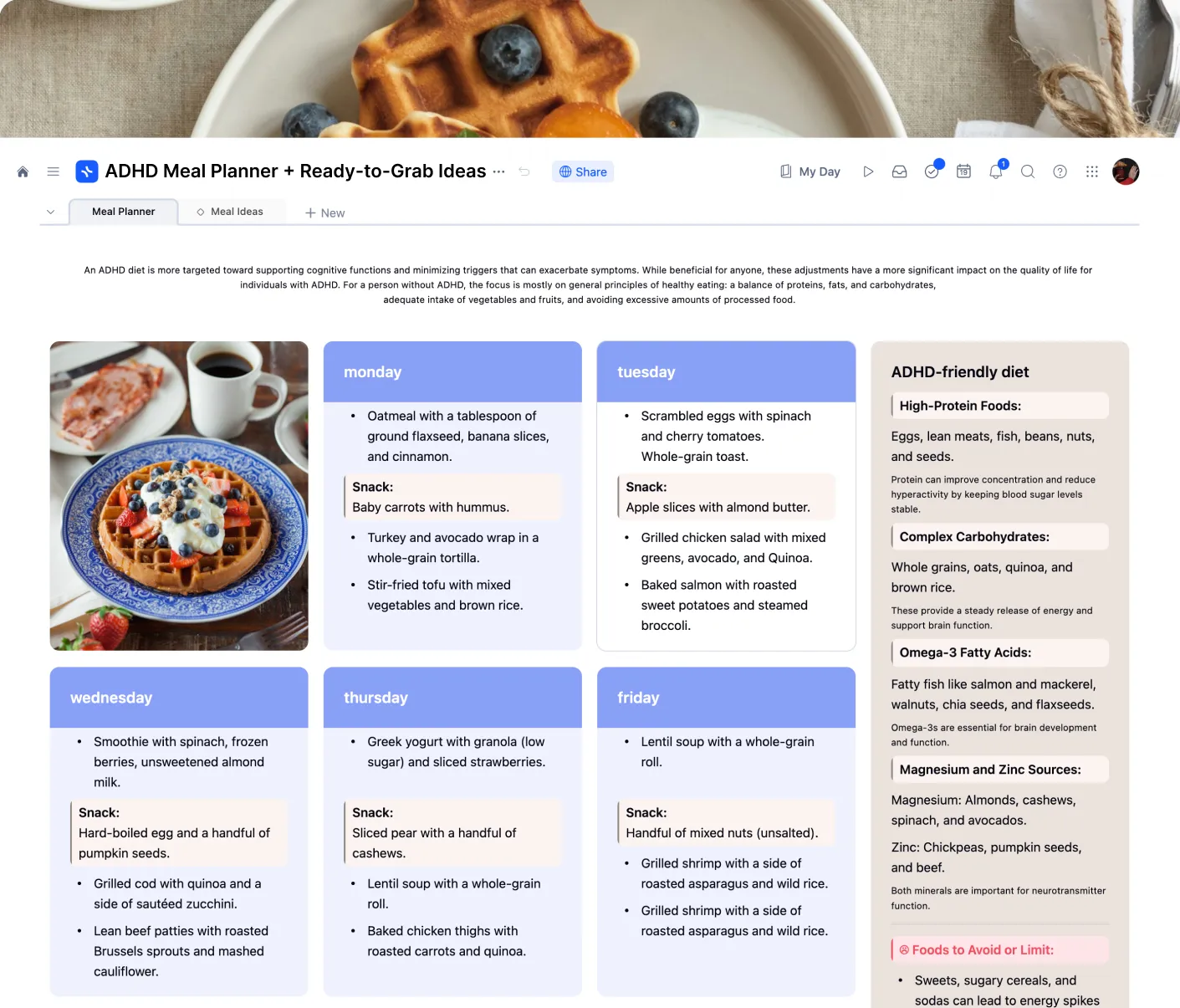
Batch the decision — once, not daily.
Pick one sitting, once a week, to lay out every meal on one board. That's the only time you're deciding. Every other day, you're just looking, not choosing.
Give the week a repeatable shape.
You don't need seven new ideas. A handful of staple meals that rotate — "the pasta one," "the sheet-pan one," "the soup one" — cuts most of the decisions before they happen. Novelty is optional, not required.
Build in a low-energy row on purpose.
Some days won't happen as planned — that's not failure, that's ADHD. Keep two or three backup meals visible on the same board specifically for low-energy days, so the fallback is a plan too, not a guilt spiral into takeout (Healthstand Nutrition).
Let the board become the list.
The same tiles you planned the week on turn directly into the shopping list — no re-deciding what you need, no second pass through your memory at the store.
See it, don't hold it.
A week laid out in tiles you can glance at removes the working-memory tax of "wait, did I plan chicken twice?" The picture holds it, so you don't have to.
Where this lives: the ADHD Meal Planner
This is exactly what the ADHD Meal Planner template gives you in xTiles: one visual week, staple meals you set once and reuse, a built-in backup row for low-energy days, and a grocery list that builds itself from what's already on the board.

You already know how you actually eat in a real week. The planner just gives that a shape you can see.