Day one, day five
Day one: a clean grid, every box empty, full of promise. Day four: you miss one day. Day five: the whole thing already feels ruined, so you close the app and never open it again.
If that's your entire history with habit trackers, the tracker was the problem — not you.
Habit trackers are built backward for an ADHD brain
- Streaks turn one gap into total failure. A tracker built on unbroken chains means a single missed day doesn't just cost you a day — it collapses the whole record, and all-or-nothing thinking does the rest: "I broke it, so why bother now" (HabitPath).
- The payoff is too far away to register. Most trackers bet everything on a distant reward — "keep going and in a couple of months it's automatic." ADHD dopamine regulation responds to what's salient right now, not to a rational promise weeks out, so that far-off payoff barely counts as a reward at all (Moore Momentum, Myndset — Incentive Salience and the ADHD Brain).
- The same square, every day, forever. A grid that never changes stops registering as something worth doing — the brain needs a bit of novelty to stay interested, and a flat, repetitive tracker offers none (softdev23 — The Dopamine Engine).
None of this means you lack discipline. It means the tool was optimized for a brain that isn't yours.
What actually works: dopamine-friendly, not discipline-friendly
Track "it happened," not "how many in a row."
Drop the unbroken chain. Every day you show up counts on its own — nothing you did yesterday, and nothing you skip tomorrow, erases it.
Reward the moment, not the milestone.
The payoff has to land the second you check something off — a tile filling in, a color changing, something visibly different right now. Don't save the only reward for "30 days in."
Keep a menu, not one habit.
Give the same habit two or three versions at different effort levels — the full version and the two-minute version — so there's always something you can actually do today. This is the same instinct behind the ADHD community's "dopamine menu": pick what matches your energy, not what matches the plan (The Neurodivergent Collective).
Let the tracker look different sometimes.
Rotate a color, resize a tile, change the layout once in a while. A tracker allowed to shift stays visible; one frozen in the same shape becomes wallpaper your brain stops seeing.
Look at the pattern, not the one broken link.
A week laid out visually shows you did the habit three out of five days — a real, working rhythm. A chain only shows you the day it snapped.
Where this lives: the Dopamine-Friendly Habit Tracker
This is exactly what the Dopamine-Friendly Habit Tracker template gives you in xTiles: no streak to protect, tiles that change color the moment something's done, a built-in easy version for low-energy days, and a week you can actually see — rhythm instead of a chain waiting to break.
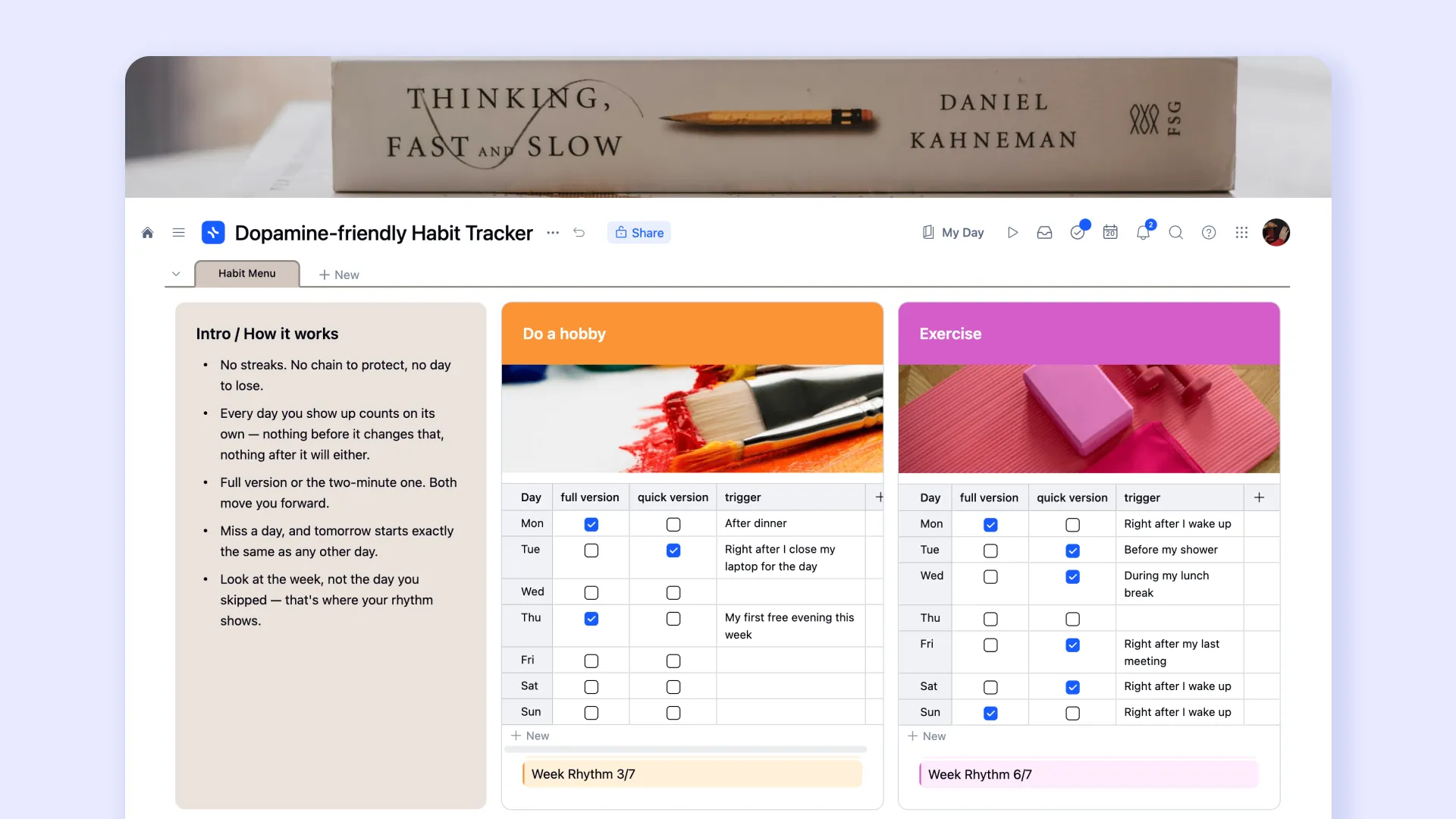
You already know what you're capable of on a real week. The tracker just gives it a shape that doesn't punish you for being human.